Guy L. Levy
Fireflies
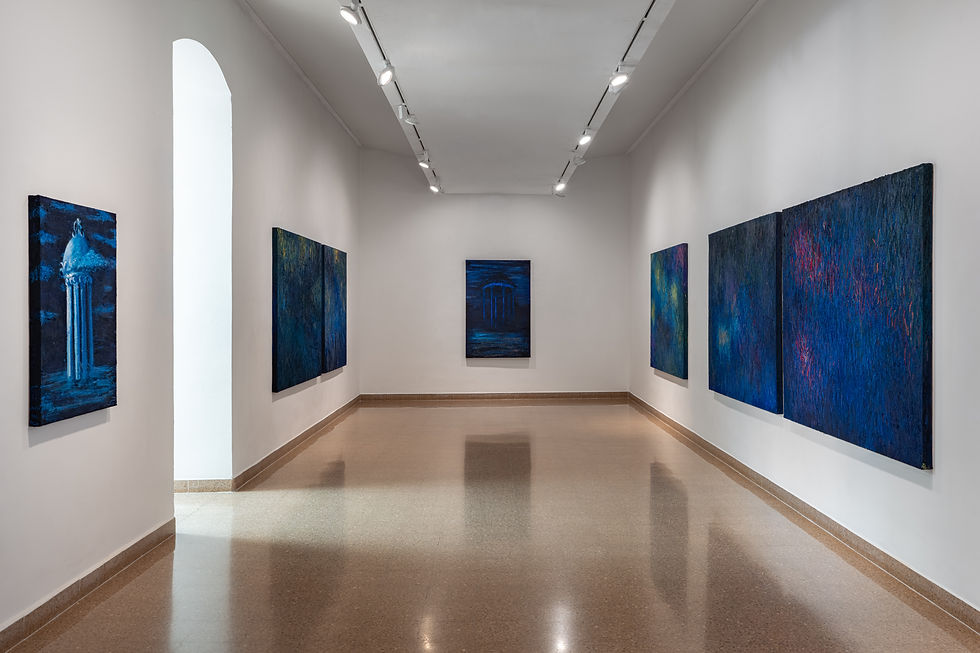
Fireflies · Solo Exhibition · Jerusalem Artists' House · Curator: Irena Gordon · June 6 - August 8, 2026 · Photos: Daniel Hanoch

Fireflies
Irena Gordon
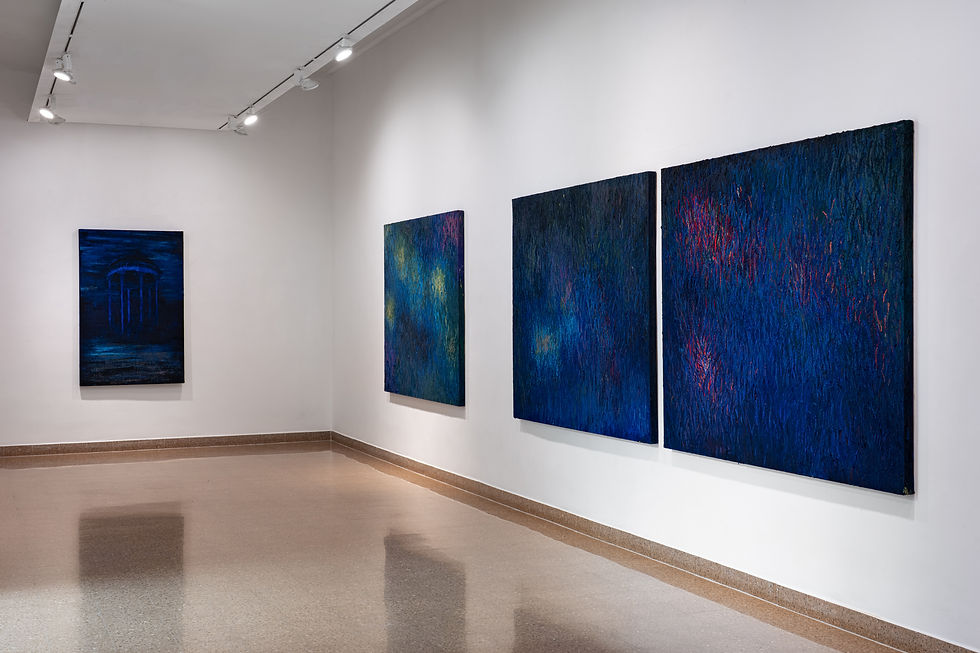
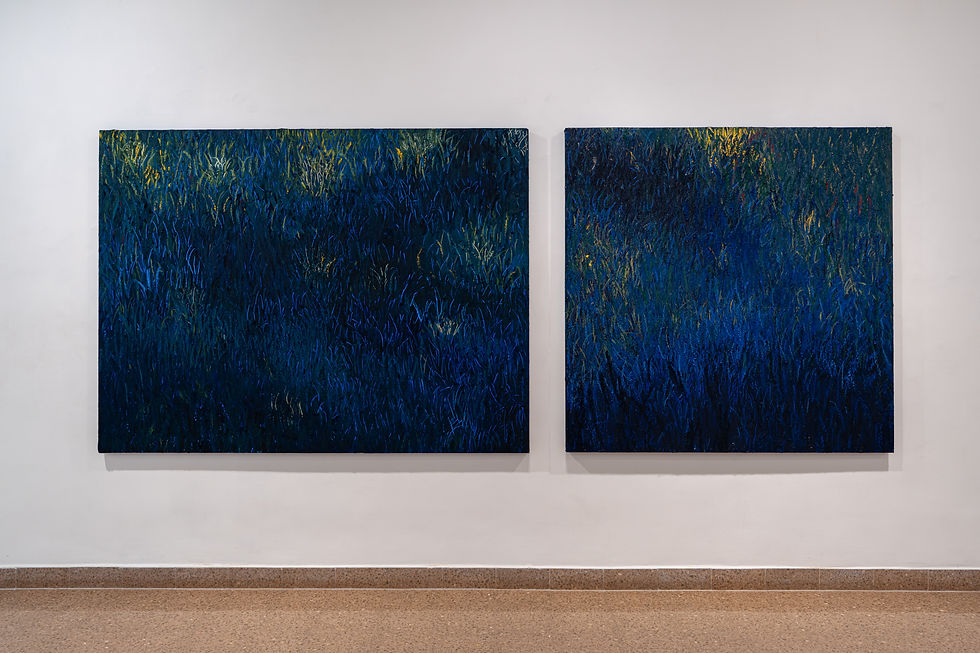
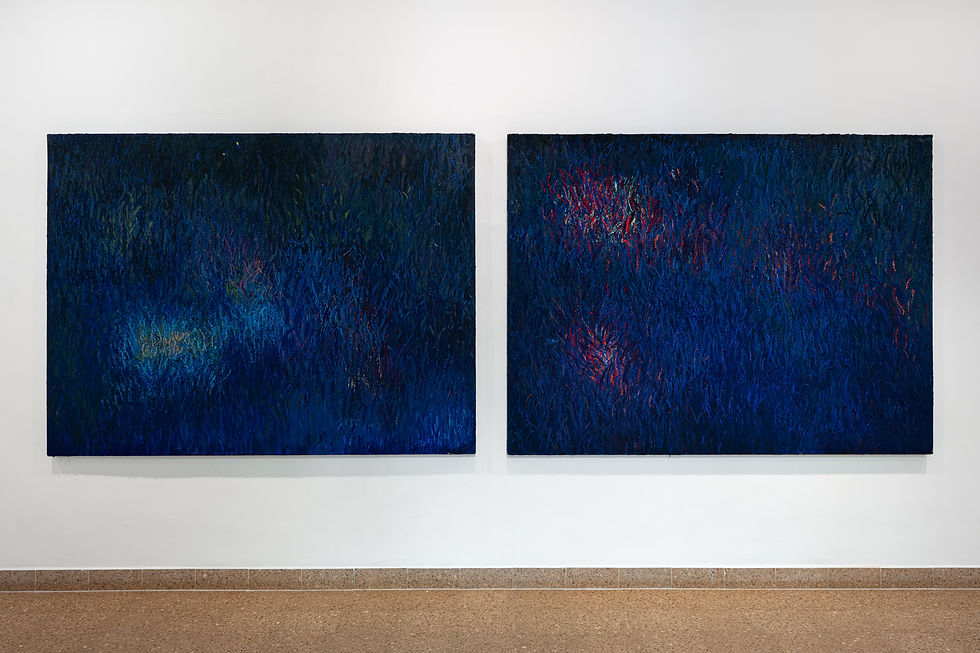
The singular, minute, ephemeral, yet immeasurably precious, lies at the heart of Guy L. Levy's new series of paintings Fireflies, which explores the persistence of light from within the depths of multi-layered blue color fields, at once direct and mysterious. Comprising large-scale paintings, the panoramic installation articulates the tension between darkness and light not as a binary conflict, but as a sequence of suspension, emergence, and disappearance. Philosopher Georges Didi-Huberman invokes the intermittent glow of fireflies—those nocturnal beetles, increasingly endangered, that emit flashes of bioluminescence to attract mates—as a metaphor for that other, unique form of existence which manages not to disappear within the sweeping, homogenizing flux of light bathing everything. Through the work with matter—applying layers of paint, incising, and subtracting—tiny, elusive, prancing glimmers erupt. From abstract depths, Levy coaxes forth sparks of counterforces.
The light beams gleaming and dancing across the paintings, seemingly born from the material itself, are the fireflies, as both image and action: presences that break through the color; a small incision of pale hue within an ocean of blue; moments of revelation—hesitation, flicker, breath—that allow the viewer not only to see the field, but to sense the inner force that brings it into being. They generate a space in which one can dwell in uncertainty and feel the tension between fear and discovery. As part of his working process, Levy prepares his paints from a mixture of wax, pigments, and oil. The resulting material allows him not only to add layers, but also to remove, scrape, incise, and open the painting from within.
In earlier bodies of work, Levy presented narrative historical–mythological scenes in which figures, possibly heroic, are placed in dramatic situations of struggle, threat, and violence. These figures appear, for the most part, as silhouettes moving within dark blue compositions set against red-orange-yellow expanses—fiery apparitions that illuminate the events, transforming them into scenes of either creation or chaos. For Levy, blue functions as a charged space of depth, dreaming, suspension, and alertness: a color that carries the traces of action and tension accumulated throughout the working process, becoming inseparable from the way the scenes unfold in the painting. Blue thus generates human–nature relations in the spirit of the Romantic sublime: pain, terror, or fear interwoven with spiritual pleasure in the face of nature's magnitude, arising from the human capacity to grasp the infinite despite physical limitation.
In other paintings, Levy places follies—nonfunctional, decorative architectural structures in diverse styles, characteristic of eighteenth-century European landscape design—within blue, quasi-romantic compositions evoking the spirit of the sublime. These structures have long served as a means of fashioning gardens into idyllic pictures, embodiments of order and reason. In Levy's work, these images of "follies" stand as the ghosts of culture, signaling its fragility.
Levy: "In the current paintings, I revisit the field in which the child got lost—a field that is not a familiar landscape, but an inner space, a terrain of memory. The fields in the exhibition emerge from dark, dense, almost opaque layers, containing the tension between straying and orientation. Far from empty, this darkness is dense, vibrating, and full of internal movement seeking an outlet. The resulting textures are reminiscent of burrows, leaves, grass, water—networks of lines alluding to the field's restlessness, its breathing, and the way darkness moves from horizon to horizon.
The works were born from a recent experience: walking through Central Park in total darkness, a moment in which the entire world became a single color—a deep blue-black, without horizon or direction. Within this thick darkness, spots of luminance suddenly appeared—fireflies, both soft and stubborn. They did not illuminate the path, but rather affirmed that life continues to throb even when everything freezes. They were a testimony to existence—not a clear form of hope, but a fine, distant call. In that moment, I understood that I was returning, without intending to, to the first field, to the lost child. The paintings became a space in which two temporalities—childhood and the present—converse through light that insists on appearing. This physical act—of revealing and concealing, construction through deconstruction—echoes the act of searching: when I remove a layer, I move one step closer to the lost child; and when I add a layer, I construct a safe distance that enables observation."
In Survival of the Fireflies, Didi-Huberman discusses the intermittence of the firefly as a "lacunary image of the future": that second, "about the time that a firefly takes to flash, to call to its companions, just before darkness restakes its claim." It is an image that offers neither horizon nor a messianic promise of great light, but rather a flicker of counter-force. For Levy, the title Fireflies points to a perception of light as something that exists within darkness and in relation to it. The project as a whole seeks to propose an experience of slow observation, in which the viewer is invited to dwell, to adjust to darkness, and to recognize the small moments of luminance that appear within it. It is a continuous search for light within dense matter, for memory at the edges of consciousness, for "the child who got lost and left behind an entire field that continues to grow," in the artist's own words.