A Still Small Voice
A Still Small Voice · Solo Exhibition · Tel Aviv Artists' Studios · Curator: Eitan Buganim · Curatorial advice and text: Hadassa Cohen · November 2025 · Photos: Daniel Hanoch
And in the naked light, I saw
Ten thousand people, maybe more
People talking without speaking
People hearing without listening
People writing songs that voices never shared
And no one dared
Disturb the sound of silence
Simon & Garfunkel, The Sound of Silence, 1964
After his ostentatious battle against the false prophets failed to bring about any real change among the people, the prophet Elijah sank into frustration, despair, and a loss of direction. Defeated and heavy-hearted, he reached Mount Horeb (Sinai) and laid out his grievances before God. In response, Elijah experienced a sublime vision; a mighty wind, a roar, and a fire passed before him, yet God was not within them. It became clear to him that the divine does not answer through the force of wind, the clamorous noise, or the fire—those dramatic, intimidating manifestations—but reveals itself through a delicate breeze or absolute silence, one that does not define itself, but waits for the human response, for one’s willingness to stand, to choose, and to act.
Only after the overwhelming forces of nature subsided and a “still small voice” emerged, did Elijah experience revelation. In that moment, Elijah was granted the spiritual strength to give new meaning to his old, Sisyphean path—understanding that it is precisely within solitude and despair that the potential for transformation is hidden.
A Still Small Voice is a pulse of the soul — a quiet force, a steady frequency that calls us to listen inward. It does not absolve us of responsibility, nor erase our mistakes; yet precisely through this silence, the motivation for profound change can be carved out, allowing us to choose life from a grounded point of presence, away from the world’s distractions. Not through thunderous noise or heroic effort, but through a fine inner convergence.
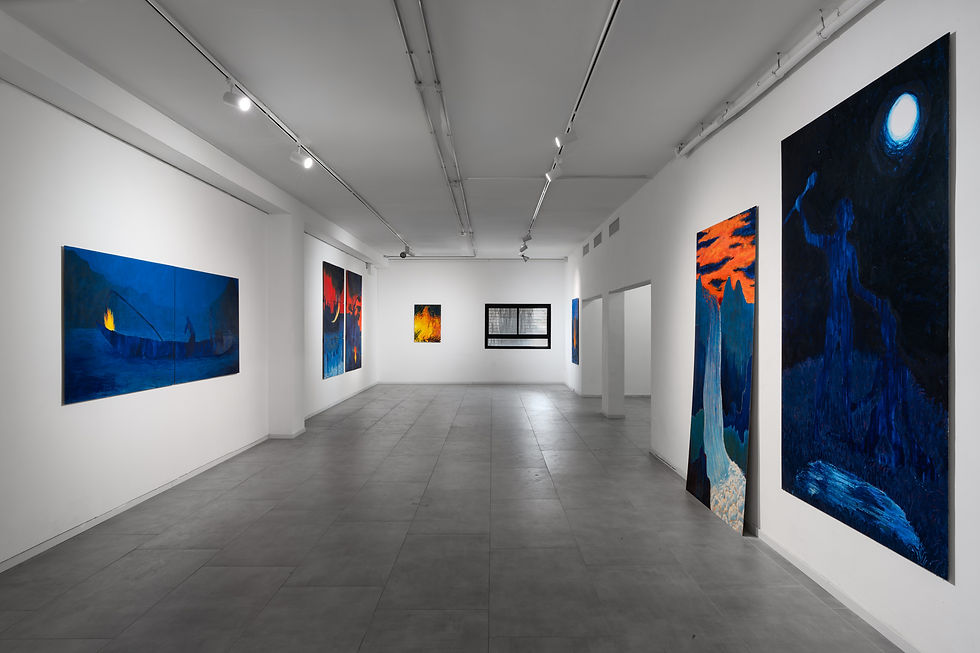
If, in its biblical origin, the still small voice signified the divine presence revealed only after the storm, then in the works of Guy L. Levy it is not a moment of comfort, but a site of tension. The artist takes this ancient experience and transforms it into the essence of a silent threat — a threshold state where forces of sea, chaos, and longing for the unknown gather at once. In Levy’s paintings, silence is not the end of struggle, but the decisive force that embodies the continuous and restless labor of the spirit to reinvent itself.
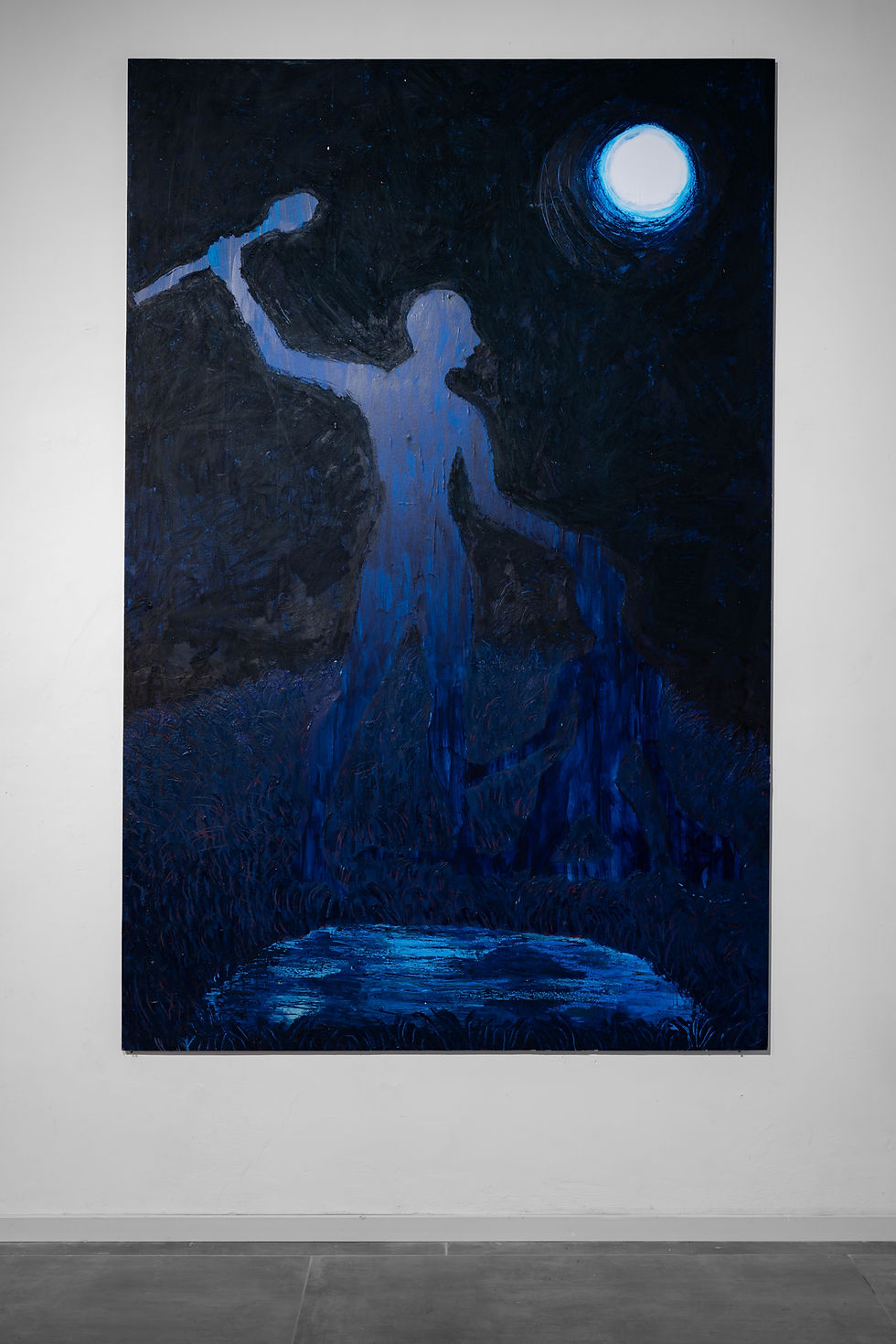
In recent years, a misty blue has become a defining motif in Levy’s work. This hue, is created by the artist himself from a mixture of powdered pigments, wax, and oil, imbues the paintings with a mythical atmosphere. The color seems extracted from dense subterranean waters or a capricious ocean, forming a translucent painterly veil in which time freezes and consciousness is subdued.
Within this silent threshold, Levy articulates an experience of drowning that is not physical but etched into the psyche as a deep knowing. Here, the outer layers crack open, revealing the archaeological interior of the mind — an exposed terrain of accumulated fears and desires.
This psychic submersion becomes the gateway to Levy’s journey. The collection of paintings traces a poetic odyssey into the unseen, built from fragments of night and nature. The blue hue holds a longing for the infinite, fusing the physical with the transcendent. Levy harnesses this symbolic charge to create a “blue experience,” anchoring the supra-sensory search in a concrete act of making. In this way, the internal quest becomes material testimony on the painted surface, where the struggle against anxiety intensifies in proportion to the deepening of color.
Gradually, what the artist calls “the community of inner voices” is revealed: an assembly of fleeting moments that blend attempts to grasp hidden sensations with flickers of dread and disaster. These voices appear as scenes of intimate encounters or late-night tales, centered around silhouettes without identifiable features. Whether in rest or action, Levy positions these figures in a state of perpetual alertness, reflecting an existential condition exposed in the depths of painting.
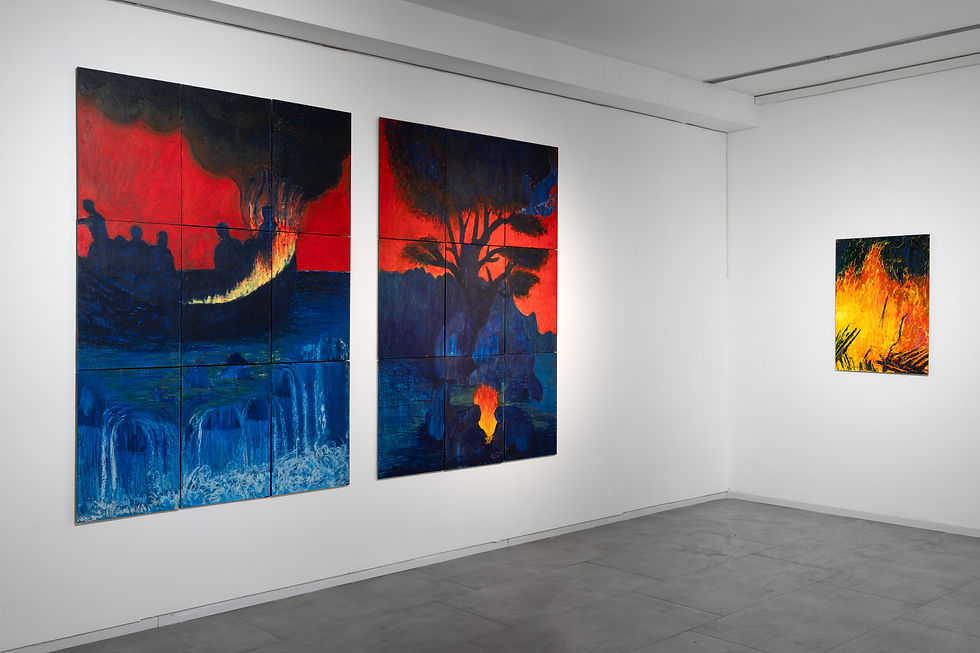
This vigilance materializes when blue turns to red; at the heart of the turmoil, alongside the figures, the image of fire emerges as a pivotal agent. Fire, an ancient symbol of eruption and upheaval, embodies existential tension. Here, art meets the myth of Prometheus — the titan who stole divine fire for humankind. The story becomes a metaphor that surpasses mythology as fire assumes a dual nature: It signifies the spark of redemption as well as the blaze of ruin. Culturally, the theft of fire is the foundational rebellion against divine authority, granting humanity its primal capacity to create and reshape its world.
Psychologically, in Jungian terms, fire represents the evolution of consciousness — a break from the unconscious into rational awareness; it is the inner light that urges self-realization. Symbolically, fire becomes a crucible of purification and transformation, hope intertwined with suffering.
In the biblical revelation to Elijah, fire is a precursor to a defining moment of silence: “and after the fire, a still small voice.” In Levy’s work, the flame articulates a state that can no longer bear what exists. Through it, we glimpse the tragedies and catastrophes seeded at the heart of civilization, awaiting their eruption. The painted presence of fire, much like the myth, anchors the dual nature of humanity — the bearer of a stolen divine spark. Levy stresses the undeniable condition: fire is an immense force, but everything depends on how we choose to wield it.
In this exhibition, A Still Small Voice stands as an existential threshold — a place where archaic threats and profound inspiration coexist. These are pre-creation moments, before the explicit voices of the world arise. The naked realization here is that true power does not lie in the wind that shatters mountains, but in the capacity to listen to the endless battle taking place within absolute silence.
Hadassa Cohen, November 2025